Foundation Settlement: What It Means for Your Wichita Home
Every foundation settles to some degree. That is not the issue. The issue is when settlement becomes uneven, meaning one part of the foundation drops more than another, or when it continues after it should have stopped. That is when doors stop latching, floors develop slopes, and cracks appear in places that make homeowners start looking up foundation repair companies.
In Wichita, the soil makes settlement more likely and more unpredictable than in most parts of the country. The heavy clay beneath most homes here swells when wet and shrinks when dry, and it does not always move evenly across a lot. Understanding what settlement is, how to recognize when it is happening, and what options exist to address it is what this article covers.
Key Takeaways
- Some settlement is normal in any home. The problem is differential settlement, where parts of the foundation move at different rates.
- Wichita's clay soil is a major driver of settlement because it expands and contracts with seasonal moisture changes, and it rarely moves evenly across a lot.
- Sticking doors, sloping floors, diagonal cracks at window and door frames, and gaps between walls and ceilings are the most common signs.
- Settlement that happened years ago and has not changed is usually less concerning than settlement that is actively progressing.
- Pier systems are the most common repair for foundation settlement in this area, driving support down to stable soil below the active clay layer.
- The earlier settlement is caught, the more straightforward the fix tends to be.
What Foundation Settlement Actually Is
Settlement is what happens when the soil beneath a foundation compresses or shifts and the foundation drops with it. In new construction, some settlement is expected as the soil adjusts to the weight of the home above it. That kind of settlement, called uniform settlement, tends to happen in the first few years and stops on its own. It does not usually cause visible problems because the whole foundation moves together.
The kind that causes damage is differential settlement, where one section drops more than another. A corner sinks while the rest stays level. One side of the foundation loses support while the other does not. The structure above has to absorb that difference, and it does so through cracks, distorted openings, and sloping floors. Two things that distinguish problematic settlement from normal settling:
- It is still moving, not something that happened years ago and stopped
- It is uneven, visible in cracks that are wider at one end, or doors that stick on one side of the house but not the other
Why Foundation Settlement Happens in Wichita
The soil under most Wichita homes is the main reason settlement is such a common issue here. Sedgwick County sits on expansive clay, which absorbs water and swells, then dries out and shrinks back. That cycle happens every year, and Wichita's climate makes it pronounced: the city averages around 36 inches of rainfall annually, with June bringing over four inches while late summer turns dry. That swing between wet and dry is what drives the soil to move.
That movement is not just at the surface. Expansive clay soils typically experience moisture-driven shrink-swell activity as deep as 15 to 18 feet below grade. A shallow foundation sitting in that active zone moves with the soil. A pier system driven below that zone reaches stable ground that does not respond to seasonal moisture changes, which is why depth matters in the repair approach.
The movement is rarely even across an entire lot. Soil near a downspout that discharges close to the foundation stays wetter longer than soil on the other side of the house. A tree with deep roots pulls moisture unevenly from one area. A section of yard that drains well behaves differently from a section that pools after rain. All of those variables mean different parts of the foundation experience different levels of soil movement, and that is what produces differential settlement over time.
Older Wichita homes have been through decades of these wet-dry cycles, and the cumulative effect tends to show up in the house rather than all at once. Settlement that took 20 years to develop is still settlement, and it still needs to be addressed before it goes further.
Signs Your Wichita Home Has Foundation Settlement
Settlement shows up in the home before most homeowners think to look at the foundation. The signs tend to cluster in one area of the house rather than appearing evenly throughout, which reflects the uneven nature of differential settlement below.
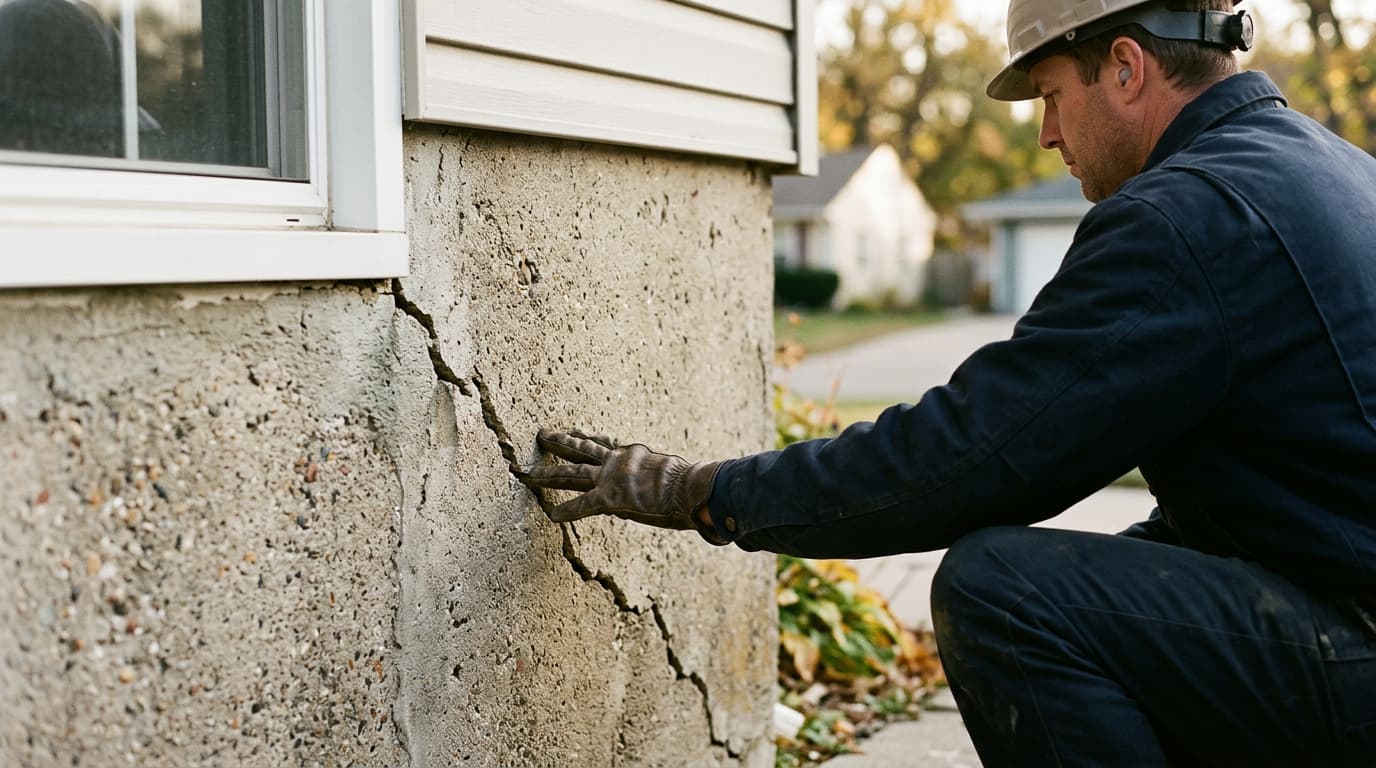
Diagonal cracks at the corners of door and window frames are one of the clearest indicators. They form at 45-degree angles from the corner of the opening, following the stress line where the frame is being pulled out of square. A floor that slopes toward one wall or feels lower in one part of a room is another common sign. Doors that stick or swing open on their own are responding to a frame that is no longer straight.
Gaps between the wall and the ceiling, or between the baseboard and the floor, show up when the structure has moved enough to pull those connections apart. Exterior brick that develops stair-step cracks along the mortar joints is a sign that the masonry has been pushed out of alignment. When more than one of these shows up in the same area of the home, a foundation inspection is the right next step.
How Foundation Settlement Is Repaired
The goal of a settlement repair is to stop the movement and, where possible, restore the foundation to level. The approach depends on what caused the settlement and how much has occurred.
The most common repair for settlement in Wichita is a pier system. Steel piers are driven or pressed down through the active clay layer until they reach stable soil or bedrock below. The foundation is then connected to those piers, transferring the home's weight off the unstable clay and onto solid ground. Once the piers are in place, they can often be used to lift the settled section back toward its original position, though how much lift is possible depends on how long the settlement has been occurring and how the structure above has adjusted to it.
For settlement caused primarily by drainage issues, addressing the water source is part of the repair. Piers stabilize the foundation but if water continues to pool against it and saturate the clay, the conditions that caused the problem persist. Improving grading, extending downspouts, and adding proper drainage around the foundation reduces the moisture variation that drives uneven soil movement in the first place.
FREQUENTLY ASKED QUESTIONS
How do I know if my foundation is still settling or if it has stabilized?
The clearest indicator is whether the cracks and symptoms are changing. Take photos of visible cracks and note the date. Check them again in a few months. Cracks that are widening, doors that are getting harder to open than they were a year ago, and gaps that are growing are all signs of active settlement. A foundation inspection can also confirm whether movement is ongoing by measuring elevations at multiple points.
Does foundation settlement affect my home's value?
Unrepaired settlement typically shows up in a home inspection and can affect a sale significantly, both in price and in whether buyers proceed at all. Repaired settlement, with documentation of the work done, is a different story. A properly repaired and warranted foundation gives buyers confidence that the issue was addressed professionally. The repair itself often costs less than the discount a buyer will demand for leaving it unrepaired.
Can settlement be prevented?
Not entirely, but the rate and severity can be reduced. Keeping water away from the foundation through proper grading and drainage is the most effective step a homeowner can take. Avoiding large trees close to the foundation eliminates a major source of uneven moisture extraction from the soil. In Wichita's climate, managing drainage is particularly important because the wet-dry swing is pronounced and the clay responds to it directly.
Is foundation settlement covered by homeowner's insurance?
Rarely. Most standard policies exclude settlement damage because it is considered a gradual process rather than a sudden event. Settlement resulting from a specific covered event, like a plumbing failure that saturated the soil, may have a path to coverage, but that is a narrow exception. Check your specific policy and speak with your insurer directly if you think a covered event may have contributed.
When to Consult a Professional in Wichita
If you are seeing diagonal cracks, doors that changed behavior in the last year or two, floors that feel off, or gaps that were not there before, do not wait for a second season of movement to confirm what you are already seeing. Settlement that is caught while it is still localized is a much smaller job than settlement that has had time to spread through the structure.
Chief Cornerstone Foundation has worked with Wichita homeowners through enough Kansas wet seasons to know what active settlement looks like and what it takes to stop it. Schedule a foundation inspection or call us at (316) 365-0032 and we will tell you straight what is happening and what it needs.
Settlement Does Not Fix Itself. The Sooner You Know What You Are Dealing With, the Better.
Most Wichita homeowners who deal with foundation settlement wish they had called sooner. Not because the repair was catastrophic, but because by the time they called, the job had grown past what it would have been a year or two earlier. An inspection tells you where things stand. It might confirm that what you are seeing is old movement that has stopped, which means no repair needed right now. Or it might confirm active settlement that is worth addressing before another wet Kansas spring works on the soil beneath the house. Either way, knowing beats guessing.