Slab Foundation Problems Wichita Homeowners Should Know
Slab foundations look simple. A thick pad of concrete, the house on top, nothing underneath. What could go wrong?
Quite a bit, it turns out, especially in Wichita. The clay soil beneath most homes here expands when it soaks up spring rain and shrinks when summer heat dries it out. A slab sitting directly on that soil takes the full force of that movement across its entire surface. When the clay moves unevenly, the slab cracks, heaves, or settles in sections, and the house above starts to show it.
Slab foundations became common in Wichita from the 1960s onward, so many of the homes built in the last 60 years sit on one. Knowing what problems to watch for, what causes them, and what a repair actually looks like is practical knowledge for anyone who owns one of those homes.
Key Takeaways
- Slab foundations sit directly on the soil with no crawl space beneath them, which means every movement in the ground transmits directly to the concrete.
- Wichita's expansive clay soil is the main driver of slab problems. It moves with the seasons, and it does not always move evenly.
- Slab repairs are more involved than pier and beam repairs because there is no open space to work in. Fixing a slab problem means working through or beneath the concrete.
- Drainage is almost always part of the conversation. Water that pools against a slab foundation accelerates every problem on this list.
How a Slab Foundation Works and Why Wichita Soil Challenges It
A slab foundation is a reinforced concrete pad, typically four to six inches thick, poured directly on compacted soil. The home sits on top of it. Plumbing runs through the slab before it is poured, which is why a slab plumbing leak is such a significant repair: you have to get through the concrete to reach the pipes.
The slab works well when the soil beneath it is stable and uniform. In Wichita, stability is the variable. Sedgwick County sits on Hydrologic Group D soils, the highest classification for moisture retention and shrink-swell activity in the USDA system. Wichita averages about 36 inches of rainfall per year, concentrated heavily in spring, followed by a hot, dry summer that pulls moisture back out of the ground fast. When that clay absorbs water, it can expand by 10 percent or more in volume. That is enough pressure to crack concrete. When it dries out, it pulls back, leaving sections of the slab without the support they had before. A slab absorbs that cycle across its entire surface, and concrete does not flex gracefully. It cracks.
The question for most Wichita slab homeowners is not whether the soil is moving. It is whether the slab has developed a problem because of it.
The Most Common Slab Foundation Problems in Wichita
Slab cracks
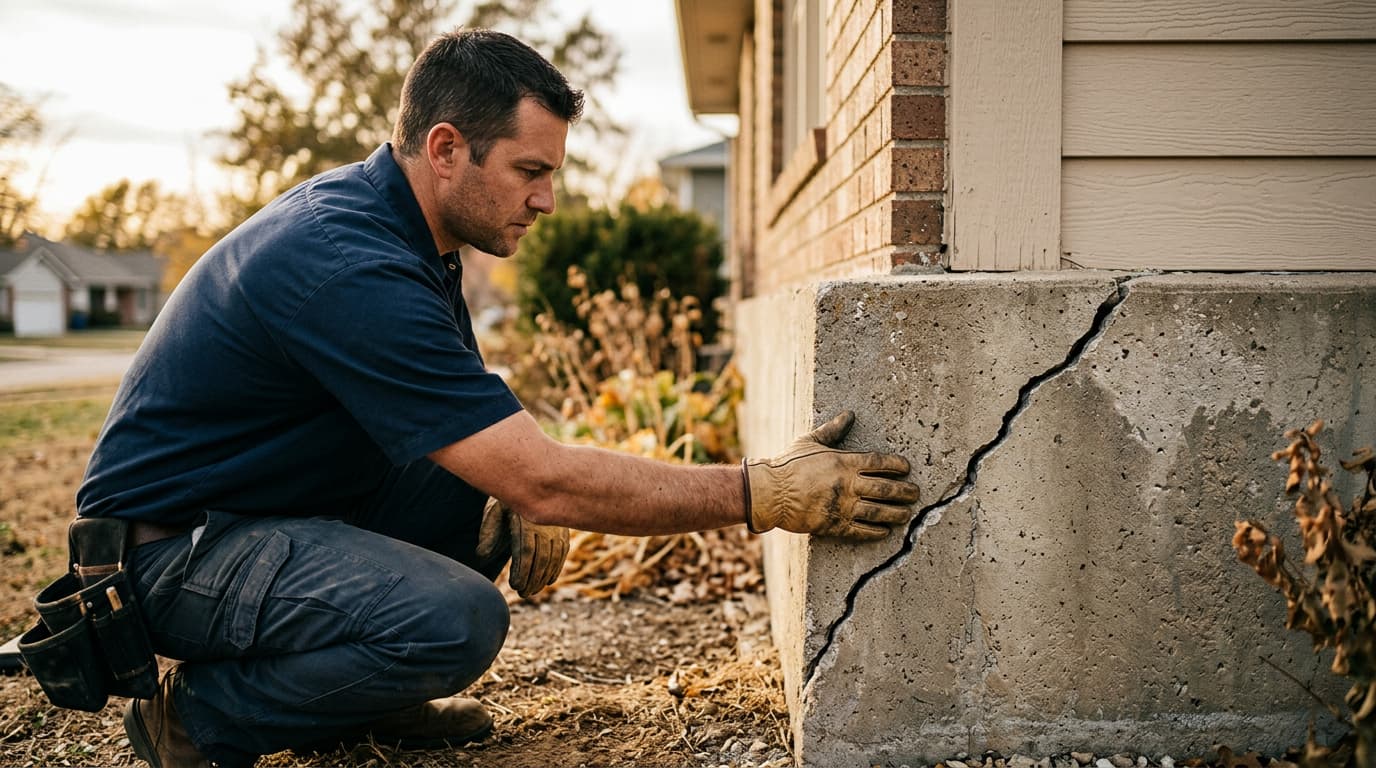
Not all cracks in a slab are structural. Hairline cracks that run in no particular direction and have not changed in years are often the result of normal curing and are not a cause for concern. The ones worth watching are diagonal cracks, cracks that run across a large section of the slab, and cracks that are wider at one end than the other. Those patterns indicate that the slab has moved and the crack formed along the stress line.
Slab heave
When clay soil absorbs moisture and expands, it pushes upward. If that upward pressure is uneven, part of the slab lifts while the rest stays level. Floors that feel raised or bumpy in one area, tiles that crack along grout lines, and doors that stick at the top rather than the bottom are all consistent with slab heave. It tends to show up most noticeably after a wet spring.
Slab settlement
The opposite of heave. When soil dries out and contracts beneath one section of the slab, or when poorly compacted fill settles over time, that section of the slab loses support and drops. Floors that slope toward one wall, doors that stick at the bottom, and diagonal cracks at window and door frames are the most common signs. Settlement and heave can occur in the same home in different areas, because the soil does not move evenly across a lot.
Slab moisture intrusion
Water can enter through cracks in the slab, through the joint where the slab meets the foundation wall, or through the slab surface itself when water pressure from saturated soil builds up against it. Damp floors, efflorescence (white mineral deposits on concrete), and musty smells at floor level are the signs. In Wichita's wet springs, homes with drainage problems close to the foundation are particularly exposed to this.
What Slab Problems Look Like Inside the Home
Slab problems show up in the walls and floors before most homeowners think to look at the foundation. Diagonal cracks running from the corners of door and window frames are the most recognizable sign. They follow the stress line of a slab that has moved unevenly and pulled the wall framing with it.
Floors that feel uneven underfoot, tiles that have cracked along grout lines without an obvious cause, and gaps between the baseboard and the floor are all worth noting. Doors that changed behavior over the last year or two, either sticking at the top or the bottom, reflect movement in the frame above the slab. Exterior brick with stair-step cracks along the mortar joints is one of the clearer outside indicators that the masonry has been pushed out of alignment by slab movement.
When several of these appear in the same area of the home, the pattern points to the slab beneath that area. A foundation inspection is the right step to confirm what is happening and how far along it is.
How Slab Foundation Problems Are Repaired
Slab repairs are more involved than pier and beam repairs because there is no open space beneath the floor to work in. Every repair that addresses what is happening under the concrete requires either going through it or around it.
For settlement, the most common repair is a pier system. Steel piers are pressed through the soil from the exterior perimeter of the slab until they reach stable ground below the active clay layer. Once in place, the piers support the slab and can often be used to lift settled sections back toward level. The work stays largely outside the home, though interior access points may be needed for sections far from the perimeter.
For moisture intrusion through cracks, the cracks get sealed using an injection process that fills the void in the concrete. But sealing a crack without addressing what caused it is a temporary fix. If drainage around the foundation is allowing water to pool against the slab, that problem has to be resolved alongside the crack repair. Homes in Wichita where water is consistently directed toward the foundation rather than away from it will continue to develop moisture problems regardless of how many cracks get sealed. Correcting the drainage around the foundation is what makes the repair last.
FREQUENTLY ASKED QUESTIONS
Are all slab cracks a problem?
No. Hairline cracks that have not changed in years are often the result of the concrete drying and hardening after it was poured, and are not structurally significant. The ones that warrant attention are cracks wider than a quarter inch, diagonal cracks at door and window frames, and any crack where one side of the concrete is higher than the other. If you are not sure, a foundation professional can assess which category your cracks fall into.
How do I know if my slab has heaved or settled?
The direction matters. Doors that stick at the top and floors that feel raised or bumpy point toward heave, where the slab has been pushed upward. Doors that stick at the bottom and floors that slope toward a wall point toward settlement, where the slab has dropped. Both can happen in the same home in different sections.
Will slab problems get worse on their own?
If the soil conditions driving them do not change, yes. Each wet-dry cycle in Wichita works on the clay beneath the slab, and problems that develop incrementally tend to continue incrementally. Settlement that starts as a slightly sticky door can progress to visible floor slopes and structural cracks over several seasons. Addressing it earlier keeps the repair smaller.
Can I sell a house with a slab foundation problem?
You can, but it will come up in the inspection and affect the sale. Buyers will typically want the issue repaired or will discount their offer significantly to account for the cost. A repaired and documented foundation problem is a much easier conversation than an unrepaired one.
Does a slab foundation require more maintenance than pier and beam?
Not more maintenance, but different maintenance. A slab does not have the crawl space moisture issues that pier and beam homes deal with. But it is more sensitive to drainage conditions around the perimeter and harder to repair when something does go wrong. Keeping water away from the slab and watching for early signs of movement are the most important things a slab homeowner can do.
When to Consult a Professional in Wichita
If you are seeing diagonal cracks, changing floor levels, or doors that behaved differently after last spring than they did the year before, get it looked at before another Kansas wet season runs. Slab problems in Wichita tend to develop slowly and then accelerate. Catching them in the slow phase is when the repair stays manageable.
Chief Cornerstone Foundation works with slab foundations across Wichita and knows how the local clay behaves under them through the seasons. Schedule a foundation inspection or call us at (316) 365-0032 and we will tell you straight what is going on and what it needs.
Your Slab Has Been Absorbing Wichita's Seasons for Years. It Might Be Time to Check In.
Slab foundations handle a lot in Kansas. Wet springs that saturate the clay, dry summers that pull the moisture back out, and the slow cumulative effect of years of that cycle on the concrete above it. Most slabs hold up well. Some develop problems that are easy to miss until they have been building for a while. The signs are there before the damage gets serious, if you know what to look for. This article is a start. An inspection finishes the picture.