Concrete Foundation Cracks: Which Ones Actually Matter
Not every crack in a concrete foundation is a problem. Some are normal. Some are not.
The challenge for most Wichita homeowners is that they all look alarming when you first see them. A crack in the foundation wall or the basement floor triggers immediate anxiety, and without knowing what to look for, it is hard to know whether you are dealing with something that needs attention now, something worth monitoring, or something that has been sitting there harmlessly since the house was built.
This article breaks down the types of concrete foundation cracks that show up in Wichita homes, what each one typically means, and how to tell the difference between a crack that warrants a call and one that does not.
Key Takeaways
- Hairline cracks that have not changed in years are usually harmless. Cracks that are wide, diagonal, or changing are not.
- The direction and pattern of a crack tells you more than its size alone. Horizontal cracks are the most serious type in a foundation wall.
- In Wichita, clay soil movement is the most common driver of cracks that actually indicate a foundation problem.
- A crack that lets water in is always worth addressing, even if it is not structurally serious on its own.
- Monitoring cracks with dated photos over several months is the best way to know whether movement is active or old.
The Cracks That Are Usually Fine
Concrete shrinks slightly as it dries after being poured. That process, which happens in the weeks and months after construction, often produces hairline cracks that run vertically or in no particular pattern. They are narrow, typically less than one sixteenth of an inch wide, and they do not grow. Most homeowners who find them years after the house was built are looking at something that formed during the first season of the home's life and has not moved since.
Vertical cracks in a poured concrete wall that are uniform in width from top to bottom fall into the same category. They tend to form as the concrete cures and the wall adjusts to the load above it. As long as they are not widening, not letting in water, and not accompanied by other symptoms in the house, they are usually cosmetic.
The key test for any crack you are unsure about: take a photo with a date stamp and check it again in three months. A crack that has not changed over two or three seasons of Wichita's wet-dry cycle is almost always old movement that stopped on its own.
The Cracks Worth Watching
Some cracks sit in the middle category: not immediately serious, but not something to ignore either. These are the ones that deserve monitoring and sometimes professional assessment before drawing a conclusion.
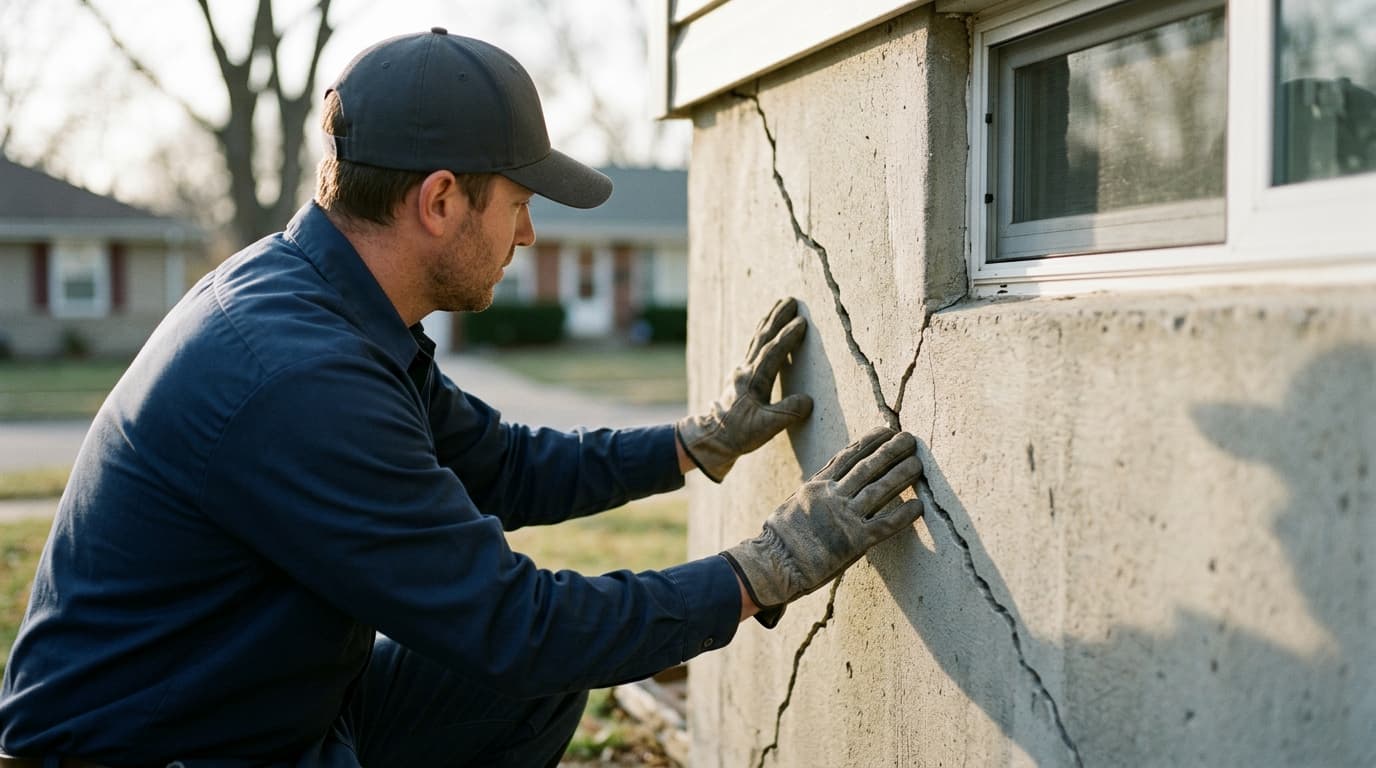
A vertical crack that is wider at the top than the bottom, or wider at the bottom than the top, is telling you that the wall has moved unevenly. The concrete cracked along the tension line where one section moved differently from another. That pattern is worth documenting and watching. If the width difference grows, it is active movement and warrants an inspection.
Stair-step cracks in block or brick foundations follow the mortar joints in a diagonal pattern across the wall. They are more common in older Wichita homes built with concrete block rather than poured concrete. A single stair-step crack that has not changed is often just settlement from decades ago. Multiple stair-step cracks, or one that is growing, points to ongoing soil movement that needs to be addressed.
Any crack that allows water into the crawl space or basement after rain belongs in this category regardless of its size or pattern. The crack may not be structurally serious, but water intrusion through a foundation wall accelerates every problem it reaches, from wood rot in a crawl space to mold on framing. Sealing it is worth doing even when the crack itself is small.
The Cracks That Need Attention Now
Horizontal cracks in a foundation wall are the most serious type. A horizontal crack means the wall is being pushed inward by soil pressure from the outside. In Wichita, this happens when clay soil saturates and expands against the foundation wall with enough force to bow it. The wall is not just cracked. It is being displaced. Left without intervention, the wall can fail. This is not a crack to monitor. It is a crack to have inspected immediately.
Diagonal cracks that run from the corner of a window or door frame at roughly 45 degrees indicate that the foundation has moved unevenly beneath that section of the house. The crack is following the stress line of a frame being pulled out of square. These are common signs of differential settlement, and they tend to come with sticking doors and sloping floors in the same area. When one shows up, checking for those companion symptoms is the next step.
A crack where one side of the concrete is visibly higher than the other, called displacement, means the two sections have moved in different directions. That is not a shrinkage crack. It is active movement that needs professional assessment. A foundation inspection is the right next step for any crack in this category.
Why Wichita Foundations Develop More Cracks Than Most
Sedgwick County sits on expansive clay that the USDA classifies as Hydrologic Group D, meaning it has the slowest drainage and highest shrink-swell potential in the federal classification system. That clay can expand by 10 percent or more in volume when it absorbs moisture. Wichita averages about 36 inches of rainfall per year with June bringing over four inches, followed by a hot, dry summer that pulls moisture back out of the ground fast. The soil swells against the foundation, then shrinks away from it, then swells again. Every cycle puts stress on the concrete.
Homes that have been in Wichita for 30 or 40 years have been through that cycle dozens of times. The cracks that develop are not a sign of poor construction. They are a sign of concrete doing what concrete does under repeated stress: it finds the weakest point and opens along it. The question is always whether that opening represents past movement that stopped or current movement that is still happening.
And that question is exactly what a foundation inspection is designed to answer.
FREQUENTLY ASKED QUESTIONS
How wide does a crack have to be before it is a problem?
Width alone is not the best measure. A hairline crack that is stable is less concerning than a narrow crack that is actively growing. That said, any crack wider than a quarter inch deserves a professional look, especially if it is diagonal or if one side is higher than the other. Width combined with pattern and whether it is changing gives you a much clearer picture than width alone.
Can I fill a foundation crack myself?
For small, stable, non-structural cracks that are letting in water, a polyurethane or epoxy injection can be a reasonable DIY fix to stop moisture intrusion. It does not address what caused the crack or whether the foundation is still moving. If the crack has any of the warning signs described in this article, getting a professional assessment before filling it is the right call. Filling an active crack without understanding the cause is a temporary patch, not a repair.
Do foundation cracks get worse in winter?
They can. Kansas winters bring freeze-thaw cycles that expand water inside existing cracks. When water gets into a crack, freezes, and expands, it widens the crack slightly each cycle. A crack that looks the same in September may be noticeably wider by March. This is another reason to document cracks with dated photos and check them across seasons rather than assuming they are stable after a single look.
Should I disclose foundation cracks when selling my Wichita home?
Yes. Kansas law requires sellers to disclose known material defects, and foundation cracks that indicate a structural issue qualify. A repaired and documented crack is a much easier disclosure conversation than an unrepaired one. Buyers and their inspectors will find the cracks regardless. Coming to the table with documentation of an inspection and any repairs made puts you in a stronger position than hoping the cracks go unnoticed.
When to Call a Professional in Wichita
If you have a horizontal crack anywhere on a foundation wall, call now. If you have diagonal cracks coming from door or window corners with sticking doors nearby, get it looked at. If you have a crack that is letting water in, seal it and address the drainage conditions causing it. And if you have any crack you are simply not sure about, an inspection will tell you which category it falls into.
Chief Cornerstone Foundation has inspected enough Wichita foundations to know what normal looks like in this climate and what does not. Schedule a free foundation inspection or call us at (316) 365-0032 and we will tell you straight which category your cracks fall into.
Not Every Crack Tells the Same Story. Knowing the Difference Is What Matters.
Concrete is honest. It does not hide what is happening beneath it. It cracks along the lines of stress and leaves a record of every season the soil below has moved, expanded, and settled back. Most of those records are harmless. A few are not. The ones that matter most in a Wichita home are the ones that tell you the movement is still going on, that water has found a way in, or that the wall is being pushed rather than just pulled. Those cracks are asking for a response. The rest are just history.