Fall Foundation Inspection in Wichita: What to Check Before Winter
Most foundation trouble in Wichita shows up quietly. A door that started rubbing in August, a crack in the garage slab that looks a little longer than you remember, a gap behind a baseboard nobody noticed in spring. Fall is when those small signs are easiest to read, and the mild weeks before winter are the easiest time to fix anything that lets water reach the foundation.
This fall foundation inspection checklist walks around the house the way an inspector would: outside first, then the rooms inside, then the crawl space or basement. You do not need special tools. A flashlight, a level or a marble, a tape measure, an old credit card, a pencil and a permanent marker cover almost all of it. Add your phone camera for photos. On most homes the whole walk takes about an hour.
Key Takeaways
- After a Kansas summer, Wichita clay is often at its driest, so many cracks and gaps are at their widest and easiest to measure.
- Start outside: foundation walls, brick joints, the soil line against the house, and where every downspout drains.
- Inside, doors and drywall corners give the earliest warning, because they react to small shifts before a floor does.
- Mark and date every crack you find. A crack that gets longer, or is wider in spring than it was in fall, tells you much more than one that stays put.
Why Fall Is the Right Time to Look
Much of Wichita sits on clay that swells when it gets wet and shrinks as it dries. After months of heat, that soil has given up a lot of its moisture and pulled back from the foundation. That is when a house tends to show its movement most plainly: cracks open a little wider, gaps appear where soil used to touch the wall, and doors that closed fine in May start to catch.
Fall also comes with a deadline. The National Weather Service office in Wichita puts the typical first fall freeze between October 20 and November 4. After that, cold snaps make soil work and crack patching harder to schedule, and most patching products need mild weather to cure. That is why a foundation inspection in Wichita before winter is worth an afternoon now, while anything it turns up can still be fixed in mild weather.
In a typical year, that first freeze lands somewhere in a 16-day stretch, so the mild weather can end with little warning.
Outside: Walls, Brick and the Soil Line
- Foundation walls. Look at every exposed section of concrete or block, including the walls inside the garage. Write down any crack wider than about 1/4 inch, any crack that runs horizontally, and any crack that is wider at one end than the other. Mark the thin vertical hairlines too, even though they matter less.
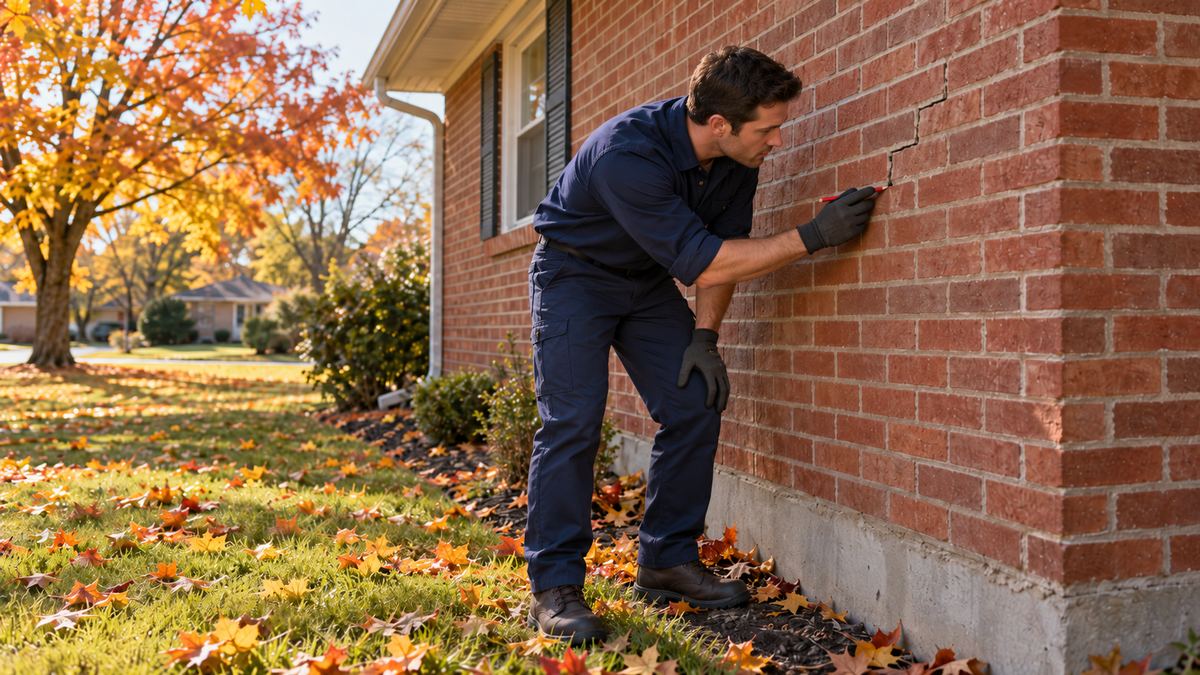
- Brick and mortar. Stair-step cracks that follow the mortar joints, bricks that have slipped out of line, and new gaps where the brick meets a window or door frame all deserve a photo.
- The soil line. Walk the perimeter and look where the ground meets the wall. A gap wide enough to slide a finger into means the clay has shrunk away from the house, and it is also an open channel for the next heavy rain to run straight down the foundation.
- Grade and downspouts. The ground should fall away from the house, at least six inches over the first ten feet, which is the standard the International Residential Code sets. Each downspout should release its water well away from the wall, not at its base. Clean the gutters once the leaves are down, and if water still collects against the house after that, a drainage installation for the low side of the lot may be the longer-term answer.
Can you see the top of the foundation wall all the way around the house, or have mulch and soil buried it?
Inside: Doors, Drywall and Floors
Inside the house, movement shows up first where rigid parts meet, like door frames and window corners. Go room by room and use this table as your checklist.
| Check | How to test it | Warning sign |
|---|---|---|
| Doors | Open and close every interior door. Look at the gap along the top of the frame. | A gap that tapers from one side to the other, or a latch that no longer lines up |
| Windows | Open each window you can. Check the corners of the frame. | Sashes that bind, or cracks running out from the corners |
| Drywall | Look above door frames, at window corners and where walls meet the ceiling. | Diagonal cracks running out from door and window corners. A crack along the ceiling line of an inside wall that opens each winter is often roof framing, not the foundation. |
| Floors | Set a marble or a level on hard floors in a few rooms. | A steady roll in one direction, or a dip that was not there before |
| Baseboards and trim | Look along the joint between trim, floor and wall. | A gap that is wider at one end than the other |
One sticking door is often humidity or a loose hinge screw. Several doors on the same side of the house, or a door that sticks this fall but did not last fall, is a pattern worth writing down.
Most interior doors are hung with a gap of only about 1/8 inch along the top and sides, which is why they react to a small shift long before a floor does.
Below: The Crawl Space or Basement
If the house sits on a crawl space, take the flashlight under it, or at least look in from the access opening. If it has a basement, walk every wall with the lights on.
- Standing water or mud on the ground, or a white chalky residue on block walls, which is mineral left behind when water passes through the masonry.
- Piers or posts that lean, or shims that have slipped out from under a beam.
- Basement walls that bow inward, or a horizontal crack running along the middle of a wall.
- If there is a sump pump, pour a bucket of water into the pit and make sure it starts. Then check where the discharge line ends. A line that empties next to the house sends the water right back, and one that sits in a low spot can freeze shut in January.
When did someone last look under your house with a flashlight?
Mark It Now So You Can Compare in Spring
One look tells you what is there. Two looks months apart tell you whether it is moving, and for most cracks, movement is what decides whether it needs attention.
For every crack worth noting, draw a short line across each end, in pencil indoors and permanent marker on outside concrete, and write the date beside it. Measure the width at the widest point. A standard credit card is about 1/32 inch thick, so a crack the card slides into is wider than that. Take a photo with a tape measure in the frame so the scale is clear, and photograph any door gap with the door closed.
In spring, after the freezes and the spring rains, repeat the walk with your photos in hand. On clay, some cracks open a little in a dry fall and close a little in a wet spring, and that alone is normal. A crack that has run past its marks, one that is wider in spring than it was in fall, a door that has gone from rubbing to not latching, or a new crack next to an old one is movement. That is what a foundation repair evaluation looks for, and a dated photo with a tape in the frame catches a 1/16-inch shift that memory will not.
What Can Wait Until Spring and What Should Not
Most of what a fall walk turns up can be marked and watched. Hairline cracks that are not growing, a single sticky door, and a narrow gap at the soil line, as long as gutters and downspouts keep roof water away from it, all belong in that group.
A few findings should not wait for the spring comparison:
- A horizontal crack in a basement or block wall, or a wall that bows inward.
- Any crack wider than about 1/4 inch, or one where one side sticks out past the other.
- Several doors or windows that started sticking in the same season.
- Water reaching the foundation or collecting in the crawl space after an ordinary rain.
Winter will not fix any of these. Water expands by about 9 percent when it freezes, so a crack near the surface that holds water can open a little more with each hard freeze.
FREQUENTLY ASKED QUESTIONS
What if my house sits on a slab, with no crawl space or basement?
Skip the section below the house and spend that time in the garage, where the slab is bare. Look for a floor crack where one side sits higher than the other, and a gap opening between the garage floor and the wall. Inside, a line of cracked tiles running across a room is worth a photo, especially near a door that has started to stick.
Is a hairline crack in a newer home a bad sign?
Usually not. Concrete shrinks as it dries, so thin vertical cracks in a home's first year or two are common.
Do I need a professional for a fall inspection?
Not for the walk itself. Everything on this list is something a homeowner can check. A professional earns their time when the walk turns up something you cannot explain, or when you are buying or selling and need someone to say what the movement means for that particular house.
How often should a Wichita home get a foundation check?
Twice a year by the homeowner, in fall and spring, plus an extra walk after an unusually wet spring or a long drought, when clay moves the most.
When to Consult a Professional in Wichita
If your walk found a crack that keeps growing, a wall that bows, or water reaching the foundation, it is worth having someone look before winter. Cracks above doors, one of the signs in the table above, are how one Wichita job on our foundation repair page started. After heavy spring rain, a family noticed them, our inspection found the foundation had shifted as the clay expanded, and steel piers lifted and secured it in three days. Our guide to what happens during foundation repair in Wichita walks through the process from the first inspection to the finished work, so nothing about it comes as a surprise.
Chief Cornerstone Foundation is a local Wichita company on North Amidon that repairs foundations on this clay. Schedule a free foundation inspection or call (316) 365-0032.
Do the Walk Before the First Freeze
Pick a dry afternoon in the next week or two. Clean the gutters, check where every downspout drains, walk the walls outside, test the doors inside, and look under the house. Mark and photograph what you find, then put a note on the calendar for April to do it again. That is the whole fall foundation inspection checklist, and the comparison it gives you in spring is worth more than any single look.