Why Wichita Yards Drain Poorly: 5 Causes Homeowners Can Spot
Rain stops. The street dries. Your yard does not.
If a corner of your lawn stays soggy for days after a storm, or water keeps collecting in the same strip along the house, the problem is rarely bad luck. Water follows the easiest path across a lot, and on most Wichita properties that path was shaped years ago by how the yard was graded, where the gutters send roof water, and what the soil underneath is made of. When any of those pieces stops working, water stops leaving and starts sitting.
The causes of poor yard drainage leave clues you can read from the ground. This article walks through five that show up again and again on Wichita lots, what each one looks like, and how to tell which one is behind the water in your yard before anyone picks up a shovel.
Key Takeaways
- Wichita's clay soil drains so slowly that most rain has to run off a yard across the surface.
- Ground that slopes back toward the house is one of the most common causes, and it usually develops in the years after construction as the soil next to the foundation settles.
- Downspouts that end a foot or two from the wall send the water from a whole section of roof into one small patch of yard.
- Gutters that overflow during storms leave that stretch of roof with no drainage at all.
- If the puddle is in the same place every time, the yard is telling you exactly where to look.
- Patios, walks and driveways that have tilted toward the house deliver their runoff straight to it. That one surprises a lot of people.
Why Wichita Yards Hold Water in the First Place
Before looking at the five causes of poor yard drainage, it helps to know what they are working against. Much of Sedgwick County sits on clay soils that the USDA places in Hydrologic Soil Group D, the slowest-draining class there is. Minnesota's stormwater manual, a common engineering reference, uses a design infiltration rate of about 0.06 inches per hour for Group D clay. Once that clay is wet, one inch of rain needs more than 16 hours to soak in, and a strong Wichita thunderstorm can drop that much in an hour or less.
So on a Wichita lot, the surface does the draining, not the ground. Grass, slopes, gutters and hard surfaces have to carry water off the property, because the soil will only take a small share of it. That is why a yard that drains fine in a light shower can turn into a pond after a June thunderstorm, and why a small mistake in how water moves across the surface shows up here much faster than it would on sandy ground.
Causes 1 and 2: The Wrong Slope and Short Downspouts
1. Ground that slopes toward the house
Building code calls for the soil around a home to fall away from the walls, at least six inches over the first ten feet. A home built to code starts out that way. The problem is what happens afterward. The soil pushed back against the foundation after it was built is looser than the undisturbed ground farther out, so it keeps settling for years. Slowly, the high point next to the wall becomes a low point, and the slope that once pushed water away starts pulling it in.
How to spot it: lay a straight 4-foot board on the ground pointing away from the house, set a level on top, and look at the bubble. If the end nearest the wall is lower, water is heading toward the house every time it rains. To measure it, lift the far end of the board until the bubble centers. The gap under it should be about 2 1/2 inches. Mulch beds that have been topped up for years can act like a reversed slope, building a lip that traps water against the wall.
2. Downspouts that end too close
A downspout gathers the rain from a whole section of roof and drops it in one spot. When that spot is a foot from the foundation, a single storm soaks a few square feet of clay that has no hope of absorbing it. The International Residential Code takes this seriously enough that in areas with expansive soils it requires roof water to be discharged at least five feet from the foundation or into an approved drainage system.
How to spot it: walk the house and look at where each downspout ends. Bare dirt, a washed-out trench, or a splash block sitting in a puddle are the giveaways. If the soggy part of the yard sits right below a downspout, you have likely found your cause.
Causes 3 and 4: Clogged Gutters and Packed Clay
3. Gutters that overflow
Gutters only work when water reaches the downspouts. Leaves from Wichita's elms and maples, seed pods, and shingle grit build up until the gutter fills during heavy rain and water pours over the edge in a sheet. At that point the house has no roof drainage along that stretch at all, and the water comes down in a line along the roof edge, a foot or two from the foundation.
The giveaway: look for a line of eroded soil or splashed mud directly under the gutter, staining on the siding, or a gutter that sags between hangers. The clearest test is to stand outside during a steady rain and watch whether water exits the downspout or spills over the top.
4. Clay that has been packed hard
Clay that already drains slowly gets worse when it is compressed. Equipment during construction, vehicles parked on the lawn and years of foot traffic along the same path all squeeze out the small air pockets water would otherwise use. A thin layer of topsoil spread over hard subsoil hides a packed layer a few inches down. The surface looks normal. It just stops taking water.
Try this: push a long screwdriver into the ground a day after rain. In loose, moist soil it goes in 6 inches or more by hand. If it stops after an inch or two in the wet area but goes in easily elsewhere in the yard, compaction is part of the problem.
Cause 5: Concrete That Tilts Toward the House
Patios, sidewalks, stoops and driveways absorb nothing. Every bit of rain that lands on them runs off somewhere, and when they were poured they were pitched to send it away from the house. On clay, slabs move. The soil under the edge nearest the house settles, the slab tips, and a patio that used to shed water toward the yard now sends its runoff straight to the foundation line.
This one is easy to miss because the concrete looks fine. The slab may not have a single crack. It is simply aimed the wrong way, and the water that collects at its edge gets blamed on the yard or the gutters instead.
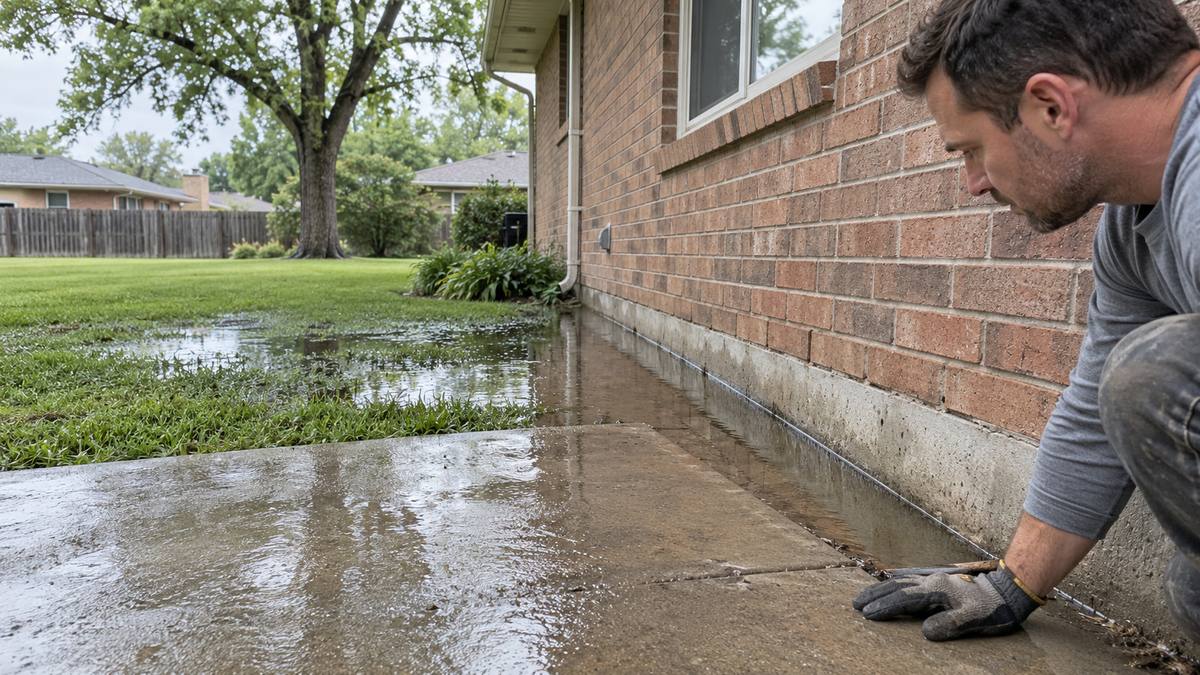
Check it after the next rain: look at where water stands on the slab and where it leaves. A wet strip along the joint between the slab and the house, or puddles that form against the wall rather than at the outer edge, mean the pitch has reversed. A level laid across the slab confirms it in seconds. Slabs next to the house rest on the same loose soil that settles along the foundation. That is why a tipped patio and a reversed grade often show up on the same lot, and why a drainage inspection should look at the concrete and the yard together.
A 20-Minute Walk That Narrows It Down
The fastest way to find which cause is behind your wet yard is to look during or right after a real rain, when the water is still moving. Start at the downspouts and follow each one to where its water goes. Then walk the perimeter of the house and note any spot where water stands against the foundation. Finish at the low areas of the lawn and trace backward to where that water came from.
Most yards show a pattern within a few minutes. Water that starts at a downspout points to cause two. Water that lands in a line under the roof edge points to cause three. Water that runs along the house from the yard points to the grade. Water that sits in one part of the lawn with no obvious source usually means a low spot or packed soil, and the screwdriver test tells you which. Water collecting at the edge of a slab points to the slab. Many Wichita lots have two of these working together, which is why fixing one can help without solving the whole problem.
Snap a few photos with the date on them. They show whether it is getting worse from one season to the next. Once you know the cause, our guide on improving the drainage around a Wichita home covers the fixes in order of impact.
FREQUENTLY ASKED QUESTIONS
How long should water stand in a yard after rain?
On Wichita clay, small puddles can linger for part of a day after a heavy storm. Water that is still standing a full day later, or that comes back in the same spot every time it rains, means something is sending more water there than the ground can handle.
Can a neighbor's yard cause drainage problems on my property?
Yes. Water does not stop at the fence line. If the lot next door sits higher, or a neighbor's downspouts discharge toward the property line, part of the water in your yard may be arriving from theirs. Watching where the water comes from during a storm usually makes that clear.
Does poor yard drainage only happen in older homes?
No. In a new home, the soil around the house is still settling, so wet spots can show up in the first few years. In an older home, the usual suspects are gutters that have filled up, downspout extensions that got knocked off, and patios that have tipped.
Will aerating the lawn fix compacted clay?
Core aeration helps the top few inches and is worth doing on compacted areas. It does not change the grade, move roof water, or fix a slab pitched the wrong way, so it works best once the larger sources of water have been dealt with.
Is it worth checking drainage during a dry spell?
Some of it, yes. You can see where each downspout ends, check the slope and slab pitch with a level, and look for mud lines under the gutters any day. The exact path water takes only shows up while it is raining.
When to Consult a Professional in Wichita
If you have extended the downspouts, cleaned the gutters and checked the grade, and water still collects in the same place, the source is something the surface does not show, or two causes are feeding one spot. Call sooner if water is reaching the foundation itself, not just the lawn.
Chief Cornerstone Foundation is a local Wichita company on North Amidon that inspects clay-soil lots like yours to find where the water is coming from and where it needs to go. Schedule a free drainage inspection or call (316) 365-0032.
The Yard Already Knows Where the Problem Is
The causes of poor yard drainage in Wichita most often come back to one of five things: the slope, the downspouts, the gutters, the soil, or the concrete. Each one leaves a mark you can find with a level, a screwdriver and one walk around the house in the rain. Start with the easy checks, fix what you can, and pay attention to what is left. Water that keeps returning to the same spot is not random. It is following directions.