How to Improve Drainage Around Your Wichita Home's Foundation
Not every drainage problem needs a contractor and a trench. A good portion of the water that ends up pressing against Wichita foundations gets there through causes a homeowner can identify in an afternoon and fix over a weekend: a downspout that dumps two feet from the wall, a flower bed that has been mounded higher than the surrounding grass, a gutter section that overflowed last spring and nobody noticed.
This article covers the improvements that make the biggest difference around a Wichita home, roughly in order of impact per effort. Some are simple. Some need equipment or a professional. All of them reduce how much water reaches the foundation, which is the only thing that ultimately matters.
Key Takeaways
- Roof water is the largest single source of foundation moisture on most lots. A 1,500 square foot roof sheds roughly 930 gallons during a one-inch rain, and downspouts decide where all of it lands.
- The ground should fall away from the house about six inches over the first ten feet. Many Wichita lots have lost that slope as the soil settled.
- Mulch beds, edging, and raised plantings against the wall trap water instead of moving it.
- Fall is the right season for this work in Wichita. Dry clay is workable and new grass has time to root before winter.
Start With the Roof: Where Most of the Water Comes From
The arithmetic surprises most homeowners. One inch of rain falling on one square foot of roof produces about 0.623 gallons of water. Run that across a typical 1,500 square foot Wichita roof and a single one-inch storm sends roughly 930 gallons down the gutters. Wichita averages about 36 inches of rain per year, with June regularly bringing more than four inches. In that one month, that roof handles something close to 3,700 gallons.
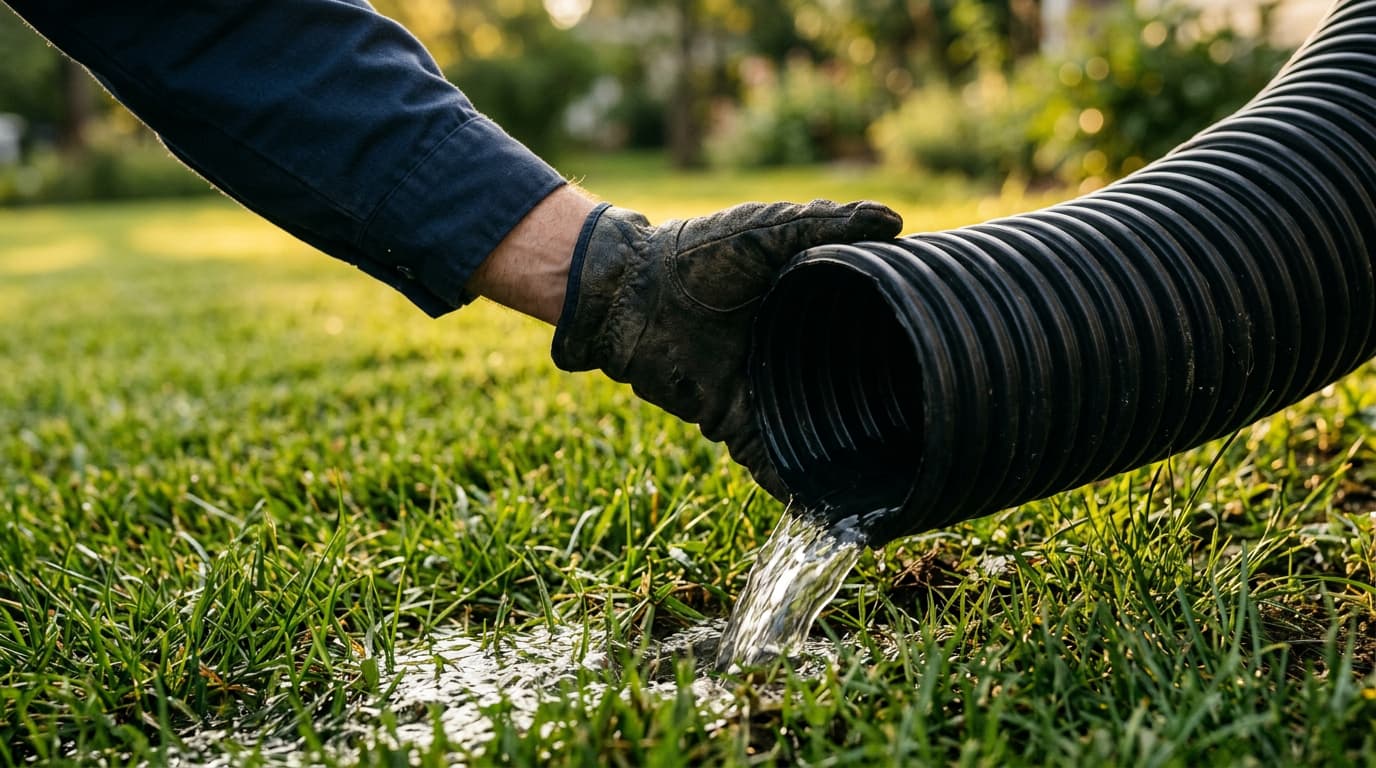
Every gallon of it goes wherever the downspouts point. A downspout discharging at the base of the wall concentrates hundreds of gallons into a few square feet of soil, repeatedly, season after season. That is the single most efficient way to saturate the clay against a foundation, and it is also the easiest thing on this list to correct. Extensions that carry the discharge four to six feet out, or buried lines that carry it farther, move that volume away from the wall for the price of an afternoon.
Gutters themselves need to be doing their job before extensions matter. Two things to check after the next storm:
- Look for streaking or staining on the siding below the gutter line, which means water is going over the edge instead of through the system
- Check the soil directly under each downspout for a washed-out trench or an eroded channel, which shows where the volume is landing
Fix the Grade: The Slope That Quietly Disappeared
When a Wichita home is built, the soil around it is backfilled and graded so the ground falls away from the walls. The standard target is about six inches of drop across the first ten feet. That slope is what sends rainwater toward the yard instead of down alongside the foundation.
Then the backfill settles. It settles most in the first few years and keeps settling for decades, and because the soil closest to the wall was the most disturbed during construction, that is where it drops the furthest. Part of that is unavoidable by design: standard practice compacts backfill against a foundation to only 85 to 90 percent of maximum density, well below the 95 percent or higher used under structural footings, because packing it any tighter risks damaging the wall during construction. That lighter compaction is exactly why the strip of ground closest to your house settles more than the undisturbed soil a few feet out. Homes that were graded correctly in 1985 can have a reversed slope today, where the ground actually tilts back toward the house. Nobody watches this happen. It shows up as a wet spot along the foundation that was not there five years ago.
Checking it takes a level and a straight board, or a string line and a tape measure. Restoring it means bringing in soil, not topsoil that drains freely, but a heavier fill that sheds water, tapered from a few inches below the siding down toward the yard. Keep the finished soil at least six inches below any siding or wood trim so the wall material stays clear of the dirt.
The Landscaping Problem Nobody Expects
Foundation plantings are one of the most common ways Wichita homeowners accidentally make drainage worse. A mulch bed along the front of the house gets topped up every spring, and after several years the bed sits higher than the lawn beyond it. Stone or steel edging holds that height in place. What was built as decoration has become a shallow basin that collects water and holds it against the wall.
Mulch compounds it. Organic mulch is designed to retain moisture, which is exactly what you want around a shrub and exactly what you do not want six inches from a foundation wall. A thick bed of it against the house keeps the soil underneath damp long after the surrounding yard has dried. In clay that already drains slowly, that extends the contact time between wet soil and concrete by days.
The fix does not mean tearing out the landscaping. It means grading the bed so it falls away from the house rather than sitting level or tilting back, keeping mulch depth modest in the first foot or two from the wall, and making sure edging does not dam the water in. Shrubs planted tight against the foundation should be pulled back or replaced with something that does not need the wall for support. If any of this reveals that water has already been sitting against the foundation for years, a drainage assessment is worth doing before the growing season starts again.
Driveways, Patios, and the Water They Send Home
Concrete absorbs nothing. Every drop that lands on a driveway or patio runs off somewhere, and on a Wichita lot those surfaces often slope back toward the house because the slab settled the same way the soil did. A patio that drains toward the back door is delivering its entire surface area of rainfall to the foundation line.
Settled slabs can often be lifted back to the correct pitch rather than replaced, which is a smaller job than most homeowners assume. Where lifting is not practical, a channel drain set across the low edge catches the sheet flow before it reaches the wall and carries it off to the side. The joint where a slab meets the foundation is also worth sealing, because an open gap there funnels surface water straight down against the wall.
After the next heavy rain, walk the property and look for what the water tells you:
- Puddles that sit for more than a day mark the low points where water collects instead of moving
- Silt lines, matted grass, and small debris trails show the paths the runoff actually took across the lot
FREQUENTLY ASKED QUESTIONS
How far should downspouts discharge from the house?
Four to six feet is the working minimum, and farther is better on a flat lot where the water has nowhere to run once it lands. What matters more than the exact distance is whether the ground at the discharge point carries the water onward or lets it pool. An extension that ends in a low spot has moved the problem a few feet, not solved it.
Can I regrade around my foundation myself?
For a modest correction along one side of the house, yes. You need fill soil that sheds water rather than loose topsoil, a way to check the slope as you work, and the discipline to keep the finished grade well below the siding. Larger regrading that involves moving real volume, working around utilities, or reshaping how the whole lot drains is where equipment and experience start paying for themselves.
Is gravel better than mulch next to the foundation?
It drains faster and does not hold moisture the way organic mulch does, which helps. It does not fix a bed that slopes toward the house or sits higher than the lawn. Gravel over a bad grade is still a bad grade, just with better drainage in the top few inches.
When is the best time to do this work in Wichita?
Fall. The clay is dry and workable instead of heavy and sticky, equipment and foot traffic do less damage to the lawn, and any grass you seed has the cool season to establish before winter. Doing it in September means the corrections are in place before the spring rain cycle starts working on the foundation again.
Will fixing surface drainage stop water already coming into my basement?
Sometimes, and it is always the right thing to try first.
When to Bring in a Professional
If you have corrected the downspouts and the grade and water is still reaching the foundation, the problem is coming from somewhere the surface does not show: groundwater moving through the soil, runoff arriving from a neighboring lot, or a low spot that no amount of fill will fix without somewhere for the water to go. That is the point where a below-grade system earns its cost. The same is true if you are already seeing water inside, wall cracks, or a foundation that has started to move.
Chief Cornerstone Foundation has walked enough Wichita lots to know which drainage problems a homeowner can solve in a weekend and which ones need equipment. Schedule a drainage assessment or call us at (316) 365-0032 and we will tell you straight which category yours falls into.
Start With the Downspouts. Work Outward From There.
Most Wichita homeowners who fix their drainage do it in this order because it matches the order of impact: downspout extensions first, then the grade along the walls, then the landscaping beds, then the hard surfaces. Each step sends less water to the foundation than the step before it was allowing. Plenty of homes never need anything beyond that list. The ones that do at least arrive at the conversation having already removed every source they could control, which makes the professional assessment a much shorter conversation.