French Drain Systems in Wichita: How They Work and When You Need One
A French drain is one of those terms most Wichita homeowners have heard without ever seeing what it actually is. There is no visible drain. No grate in the yard. When it is installed correctly, the whole system disappears under the grass, and the only evidence it exists is the part that matters: the soggy corner of the yard dries out, and the water stops reaching the foundation.
The concept is old and simple. Water flows downhill, and it takes the easiest path available. A French drain gives it an easier path than the one it is currently taking through your yard or against your foundation wall. This article explains how the system works, where it fits among the drainage solutions available to Wichita homes, and how to know if your lot actually needs one.
Key Takeaways
- A French drain is a gravel-filled trench with a perforated pipe that intercepts water and redirects it away from where it is causing problems.
- It works by giving water an easier path than the one it is taking now.
- Wichita's slow-draining clay soil makes French drains both more necessary and more demanding to design than in sandier regions. The outlet is the part most DIY installations get wrong.
- A French drain solves water that moves through or across the soil. It does not fix a grading problem, and it is not the right tool for roof runoff that a downspout extension would solve.
How a French Drain Actually Works
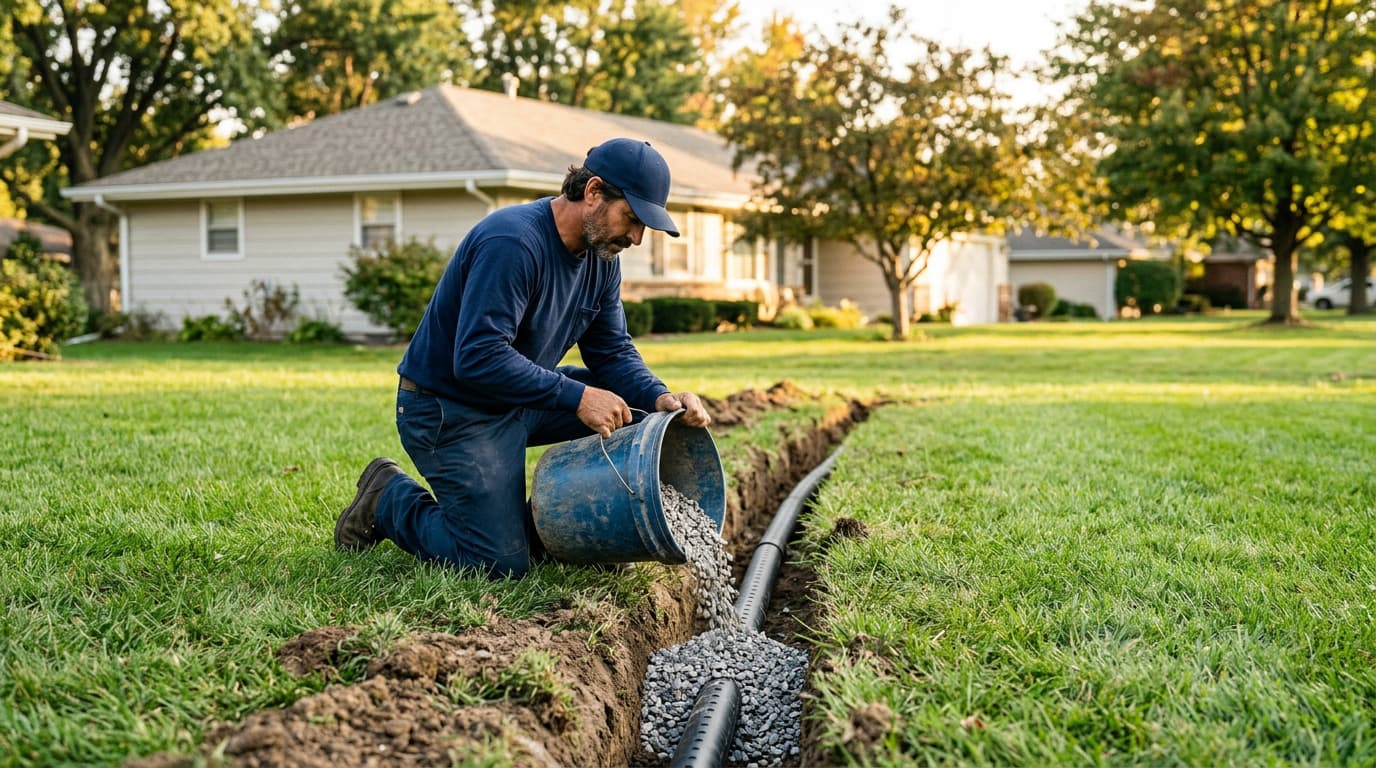
The system has three parts: a trench, gravel, and a perforated pipe. The trench is dug along the path where water needs to be intercepted, sloped so that gravity does the work. The perforated pipe sits at the bottom, holes facing down, wrapped in a fabric sock that keeps soil fines out. The gravel fills the trench around and above the pipe.
Water moving through the soil hits the gravel and follows the path of least resistance. Gravel has far more open space between its stones than the surrounding soil, especially clay, so water drops through it easily, collects in the pipe, and flows along the slope to wherever the pipe discharges. The water never pools, never saturates the surrounding soil, and never reaches whatever the drain was installed to protect.
Two details separate a working system from a failed one:
- The slope: the pipe needs steady fall along its full length, typically at least one inch of drop for every eight to ten feet of run
- The outlet: the pipe has to discharge somewhere the water can actually leave, at a low point, a storm drain connection, or a dry well
Why Wichita Lots Need French Drains More Than Most
In sandy soil, most rain soaks in where it lands. In Wichita, it does not. Sedgwick County sits on clay classified by the USDA as Hydrologic Group D, the slowest infiltration rate in the federal system. Rain that falls on a Wichita lot moves across the surface or through the top layer of soil, following the grade, until it finds a low spot. If that low spot is a corner of your yard, you get a swamp that lasts a week after every storm. If it is against your foundation, you get a wall under sustained water pressure.
The rainfall pattern makes it worse. Wichita averages about 36 inches of rain per year, and June alone regularly brings more than four inches, often in heavy bursts that arrive faster than even good soil could absorb. On clay, those bursts turn into surface flow immediately. A French drain positioned across that flow path intercepts the water before it reaches the foundation or collects in the yard.
The same clay that makes the drain necessary also makes it harder to build correctly. Dense clay walls hold the trench shape but drain almost nothing themselves, which means the system depends entirely on the gravel and pipe doing their job. There is no forgiveness in the surrounding soil. An undersized pipe, a flat section of slope, or a clogged outlet shows up as a failed drain within a season or two.
When a Wichita Home Actually Needs a French Drain
The clearest case is standing water that takes more than a day to drain after rain. A yard section that stays soggy, a strip along the fence line that never firms up, or a low area that collects runoff from neighboring lots are all situations where water is arriving faster than the clay can take it. A French drain across the upslope side of that area intercepts the water before it collects.
Water reaching the foundation is the more urgent case. If the soil against your foundation wall stays saturated after storms, if you are seeing moisture in the basement or crawl space that tracks with rainfall, or if efflorescence keeps forming on below-grade walls, a French drain along the affected side of the foundation intercepts the water before it gets there. In these cases the drain is usually part of a larger plan that includes grading corrections and downspout extensions, because foundation moisture rarely has a single source.
And there are cases where a French drain is the wrong answer. If the problem is roof water discharging next to the foundation, extend the downspouts first. If the yard slopes toward the house, regrading fixes the cause rather than intercepting the symptom. A good drainage installation assessment starts with where the water is coming from, not with the product.
What a Proper French Drain Installation Involves in Wichita
The design work happens before the digging. The installer maps where the water is coming from, where it needs to go, and what path the trench should take to intercept it. The outlet gets decided first, not last, because everything upstream depends on the water having somewhere to leave. In Wichita's flat neighborhoods, finding adequate fall for the outlet is often the hardest part of the design, and it is the reason some installations use a dry well or a connection to the storm system instead of a surface discharge.
The trench itself typically runs 18 to 24 inches deep for yard drainage, deeper when protecting a foundation. The pipe is sock-wrapped to keep Wichita's fine clay particles from clogging the perforations, and the gravel is washed and properly sized so it does not compact into a solid mass. The trench is lined with filter fabric before the gravel goes in, wrapping the entire gravel column so soil cannot migrate in from the sides. That fabric wrap is the difference between a system that lasts decades and one that silts shut in a few years.
Done correctly, the system needs little attention. Two maintenance items keep it working:
- Keep the outlet clear of leaves, soil, and vegetation so the water can exit freely
- Flush the pipe every few years to clear any sediment that made it past the sock
FREQUENTLY ASKED QUESTIONS
How long does a French drain last in Wichita's clay soil?
A properly built system with sock-wrapped pipe, filter fabric, and washed gravel typically lasts 30 to 40 years. The systems that fail early are almost always missing one of those three elements, which lets the clay fines migrate in and clog the gravel or the pipe. Periodic flushing extends the life further.
How deep should a French drain be?
For surface and yard water, 18 to 24 inches is typical. For protecting a foundation, the drain needs to be deeper, at or near the footing level, so it intercepts water before it reaches the depth where it can press against the below-grade wall. The right depth depends on what the drain is protecting, which is part of the design work.
Can I install a French drain myself?
A French drain that outlets incorrectly just moves the water problem to a different spot on your lot.
Does a French drain need a permit in Wichita?
Surface systems that discharge on your own property typically do not. Connections to the municipal storm system usually do, and discharging onto a neighboring property is not allowed regardless of permits. A licensed contractor will know what applies to your specific design and can handle the paperwork when a connection is involved.
What is the difference between a French drain and a surface channel drain?
A French drain handles water moving through the soil, collecting it below grade. A channel drain handles water moving across hard surfaces like driveways and patios, catching it through a grate before it can pool. Many Wichita lots benefit from both, each covering the type of flow the other cannot: the channel drain catches the fast surface sheet flow during a storm, the French drain manages what soaks into the ground.
When to Consult a Professional in Wichita
If part of your yard stays wet for days after rain, if water is collecting against your foundation, or if you have already tried surface fixes and the problem keeps returning, a drainage assessment will tell you whether a French drain is the right tool and where it should run. The design questions, where the water comes from, where it can go, and what depth intercepts it, are what determine whether the system works.
Chief Cornerstone Foundation has designed drainage for enough Wichita lots to know how this clay moves water and where the standard playbook needs adjusting. Schedule a drainage assessment or call us at (316) 365-0032 and we will tell you straight whether your lot needs a French drain or something simpler.
A French Drain Is Simple. Getting It Right Is the Hard Part.
Trench, gravel, pipe, slope, outlet. Five elements, and every one of them has to be right for the system to work in Wichita's clay. The lots where French drains solve the problem for decades are the ones where someone measured the fall, protected the pipe from the clay, and gave the water a real place to go. The lots where they fail are the ones where the digging started before the thinking did. If water is winning on your property, start with the assessment. The drain comes after.